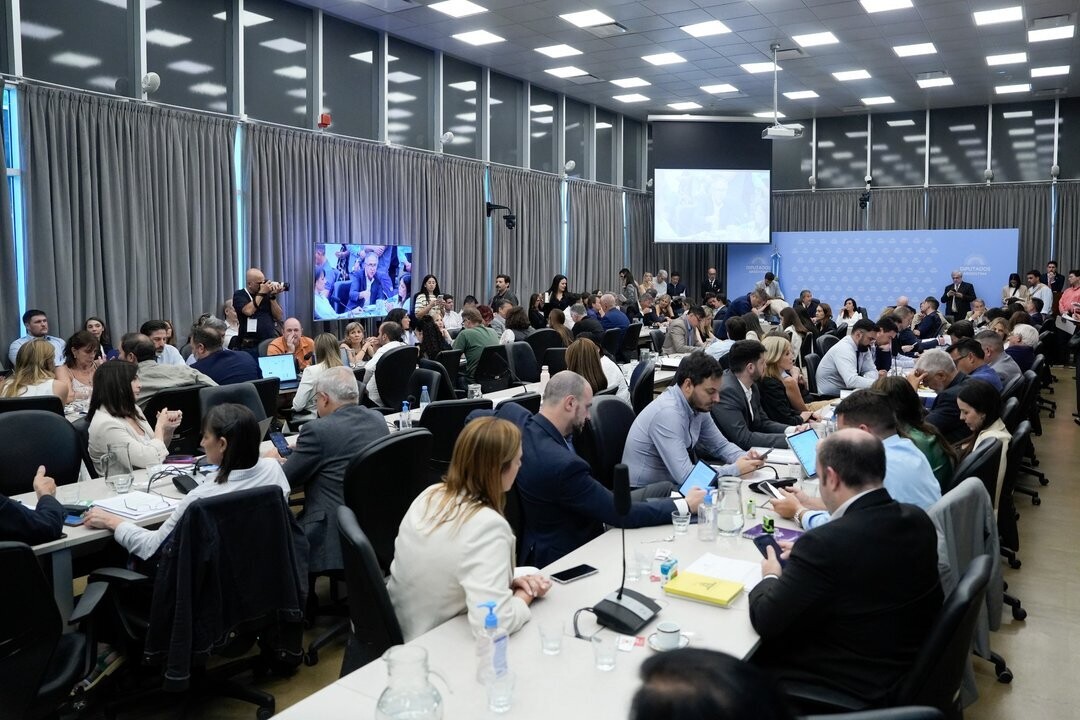
Buenos Aires, December 16 (NA) – Having successfully navigated the first round of negotiations, where it managed to secure the loyalty of allied lawmakers, the ruling bloc is preparing for a special session tomorrow. The session will seek to achieve the preliminary approval of the 2026 Budget Bill, the Tax Innocence Law, and the fiscal and monetary rule. According to the official summons, the session will begin at 2:00 PM, marking the first session of the extraordinary period. This scenario will allow the government to solidify the new balance of power that was redefined by the October elections. Time has healed the wounds left by the election results and the 'dripping' loss of deputies: the PRO party has returned as the usual ally endorsing every initiative of President Javier Milei's government and has backed the three key bills. The UCR and MID parties did the same, and together with the 'yellow' faction, they have formed the new 'Forces of Change' inter-bloc—a revival of the defunct 'Cambiemos' alliance, but with a much weaker presence than it had in the recent past. 'Innovación Federal', 'Elijo Catamarca', 'Independencia' (Tucumán), and 'Producción y Trabajo' (San Juan) complete the spectrum of alliances for the libertarian ruling coalition. This conglomerate, led by La Libertad Avanza, provided 28 signatures for the majority reports on the Budget and the Law on the National Commitment for Fiscal and Monetary Stability, and 44 signatures for the Tax Innocence Bill. The only bill facing a real risk of not being approved tomorrow is the one that establishes a strict fiscal rule, threatening criminal penalties for officials who fail to achieve a zero deficit: if enacted, the judiciary could annul the law on the grounds of alleged unconstitutionality. The Budget Debate 'We are going to show the world that we are a serious country, that we have a budget, that we know how to spend it, and that we spend it balanced for the benefit of all Argentines,' stated Gabriel Bornoroni, head of the libertarian bloc, in the plenary meeting of commissions led by Bertie Benegas Lynch. For the Córdoba-born lawmaker, 'this budget organizes the lives of all Argentines' because with fiscal balance it is guaranteed that 'we will not spend more than what comes in.' According to information from high-ranking parliamentary sources at the Argentine News Agency (NA), the heterogeneous 'Unidos' inter-bloc (whose leading party is Provincias Unidas) was attempting to unify a stance around abstention, although some PRO deputies were pushing to vote in favor of the budget, which could lead to a split vote. 'If some of ours in the bloc end up voting for the budget, perhaps some of us will vote against to balance it out,' a Unidos deputy, inclined to unify the vote around abstention, told NA. On behalf of Unidos, Nicolás Massot was in charge of presenting an alternative budget report, which, among other elements, ratifies the funds established in the university funding, pediatric emergency, and disability laws. In contrast, the ruling bloc introduced at the last minute the repeal of these two laws, which had been passed by the opposition with a two-thirds majority on two occasions, the second time to reverse President Javier Milei's decrees. Unión por la Patria, to avoid appearing passive and permissive in the face of the libertarian advance, decided that for each issue raised by the government, Peronism will present a superior counter-proposal, even if it is merely symbolic. 'We don't want to be limited to just rejection. We want to show that there is an alternative to what the government is showing,' said a leading national deputy from the main opposition bloc in a conversation with the Argentine News Agency (NA). Meanwhile, the deputy from the Left Front, Nicolás del Caño, rejected the government's proposal, denouncing that it 'not only reaffirms the 'chainsaw,' the 'blender,' and the brutal adjustment against health, public education, and retirees, but it also proposes an even greater adjustment and submission to the United States.' Criticism of the Fiscal Commitment Law In the case of the bill imposing a strict fiscal rule, Unión por la Patria presented a minority report that includes a rule for the sustainability of external debt. The proposal sets a limit on foreign currency borrowing by the State and the Central Bank and minimum terms for the entry and exit of capital. It also includes a minimum stay period for speculative capital, seeking to reduce exchange market volatility and stabilize the economy. The initiative, drafted by Itai Hagman, is flexible and counter-cyclical, enabling the State to increase spending during critical economic moments, in line with the vast majority of countries. 'The logic of permanent adjustment does not guarantee macroeconomic stability as we are seeing, and it also generates a productive and social cost that for us is absolutely unacceptable,' stated economist and member of the Patria Grande Front, Juan Grabois. The national deputy for the Civic Coalition and the Unidos inter-bloc, Maximiliano Ferraro, attacked the government's fiscal rule by calling it a 'constitutional legal monstrosity.' The opposition lawmaker considered that 'this project would not pass a first-year constitutional law course in any university.' 'Behind an objective or end that many of us share, which has to do with fiscal balance, with monetary or macroeconomic stability, is hidden or is covertly a true constitutional and legislative monstrosity, a text that is unreasonable and totally disproportionate to the objective it pursues,' he evaluated. Meanwhile, Romina del Plá (Left Front) opined that the so-called fiscal commitment 'seeks to tie the hands of deputies and congresswomen who want to propose projects in the popular interest.' She interpreted that the three laws to be voted on tomorrow have a 'common denominator' in the 'brutal contrast between the enormous benefits for large employers, tax evaders, looters, and speculators, and the attack on workers and workers.' 'It is total double standards,' questioned the legislator from the Workers' Party, who lashed out at the 'ATN festival' that the government unleashed to 'buy votes' 'brazenly.' 'It is no longer even the disguise of the ANDIS bribes,' taunted the Trotskyist leader. A few hours earlier, the head of the Unión por la Patria bloc, Germán Martínez, had shown headlines from three national newspapers reporting on the provinces that had received a discretionary injection of ATN on the eve of the Budget and the other two bills' consideration. 'That chapter is to discipline politics,' reinforced Agustín Rossi in the afternoon, who returned to the Chamber of Deputies after a long journey through various public functions. Meanwhile, Myriam Bregman (Left Front) attacked the government's plan, stating that it represents a 'colonial pact' with the United States. 'They have to ask for permission from the United States even to ask for a cup of tea,' she ironized. IP